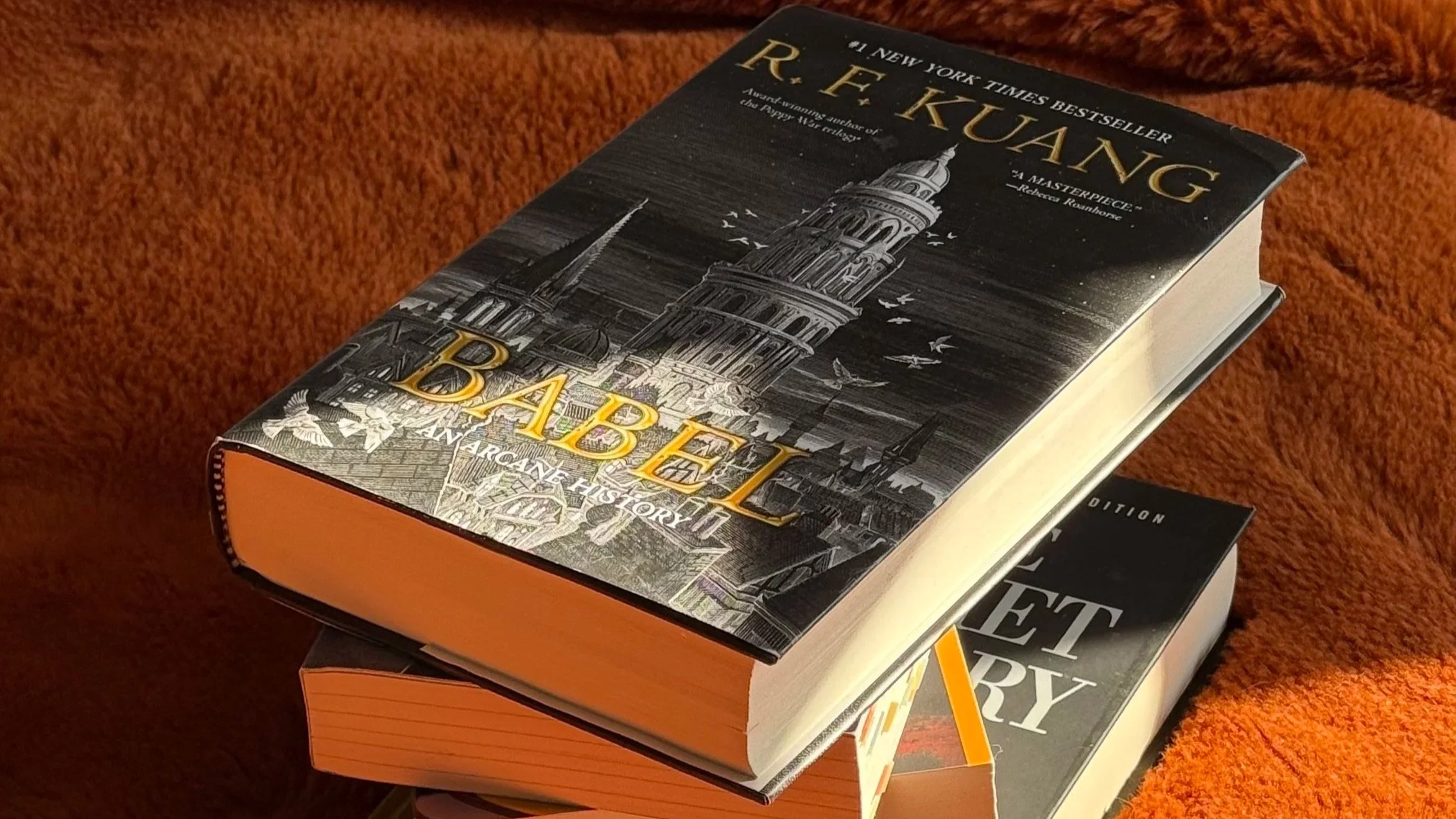
Babel by Rebecca F. Kuang
Oderint dum metuant
(‘That’s our path to victory’)
This novel has garnered more acclaim than any I can remember encountering. As you might expect, my expectations were soaring… inflated to match the hype, and perhaps a touch unrealistically so. But I wanted to know what it was all about, and so I read it anyway.
Language is power and if you've ever doubted that, this book will make it impossible to ignore.
Babel is a furious novel, part historical fiction, part academic dark fantasy, that interrogates the relationship between language, power, and empire. R.F. Kuang crafts a world that looks very much like 1830's Oxford (she includes mild annotations for those familiar with the real thing, and I liked that touch), except that translation fuels a magical industry. It is called silver-working, a technique that harnesses the gaps between words in different languages to produce real, tangible power.
This was what he wanted: a smooth, even path to a future with no surprises.
The only obstacle, of course, was his conscience
We enter through the eyes of Robin Swift, a young Chinese boy whose entire family perished before him in Canton. Taken in by the enigmatic Professor Lovell, he is uprooted from his grief and brought to England, where a rigorous and unabashedly elitist education awaits: classical languages, translation, and eventually, Oxford itself... or more specifically, its mythical Royal Institute of Translation: Babel. The magic system Kuang built around this institution is as ingenious as it is original. Silver bars engraved with words in two different languages capture what is lost in translation, and transform that loss into energy. Its etymology made kinetic, I LOVED IT.
But despite adoring his new life as a student and scholar, Robin soon realizes that disillusionment is never far behind. Oxford is everything he dreamt of : magnificent, seductive, intoxicating... and built entirely on exploitation. He gradually understands that his talent, his education, and even his identity are nothing more than instruments in service of the British Empire: a colonial machine that exploits peoples and its cultures while draping itself in the veneer of civilisation and letters.
From there, the novel becomes the chronicle of an internal rupture: can Robin hope to change this institution from within, or must he sacrifice everything for it to fall? To serve Babel is to betray his birth country, his culture, his language, his people. But to go against Babel is to lose everything he has become, everything he is now and that he loves.
The intellectual framework is formidable. The systemic and internalised racism, the misogyny woven into nineteenth-century British society, the class elitism : all of it is horribly well-rendered. And the novel's central argument, that language shapes societies and that whoever masters it holds power, resonates with what we know (especially when like me you have studied language and culture). This is a book that wants you to feel the weight of words, and as someone from a literary background, I loved the concept. I'm also from a foreign culture living in Europe and Mauritius being mentioned in the novel gave me a small, private thrill.
The footnotes, too, which I know divide readers : I loved them.
Emotionally, the first two-thirds of the novel are devastating in the best possible sense. Robin's friendships with Ramy, Victoire, and Letty, four outsiders thrown together by circumstance and bound by something realer than belonging, are the beating heart of the book.
“Ramy, Victoire, and Letty — they became the colours of Robin’s life, the only regular contact he had with the world outside his coursework”
Their bond felt layered and true. Kuang captures both the solidarity that unites them and the fractures that inevitably surface when systemic inequality is woven into the very fabric of a place.
! Careful the rest of this review is not spoiler free !
〰️
! Careful the rest of this review is not spoiler free ! 〰️
I genuinely did not see the betrayal coming because I was so enchanted by the friendship... I was convinced Letty would eventually understand their cause and join them, even while trying to dampen their emotional heights. Her decision was unexpected to me and yet entirely plausible within the logic of a world where the welcome was always conditional...
I found myself craving more of them : more time inside that dynamic, more room for it to breathe.
Which brings me, naturally, to what doesn't work. Because there are things that don't work.
The pacing is really uneven..... The opening unfolds at generous length, constructing Robin's psychology and worldview and which is, up to a point, necessary and even rewarding. But Kuang repeats herself, re-explains, hands back information the reader absorbed long ago, as though she doesn't quite trust us to keep up. And even I did, and I don't consider myself smart.
Then, paradoxically, it is the ending (the most crucial part of the book, the one to which the subtitle The Necessity of Violence lends its full weight) that is rushed through entirely. The acceleration may have been intended to convey urgency, but it read less like inevitability and more like impatience. The decision to kill everyone and prove that violence is the answer felt compressed when it deserved to land like a verdict. That was a real mistake, because the question the subtitle raises, whether change within oppressive systems is possible, or whether such systems must be broken from the outside, is provocative and uncomfortable. It deserved those last pages. It didn't quite get enough of them.
The antagonists suffer a similar problem. Lovell and Playfair are almost cartoonishly villainous. I understand that they function as symbols of imperialism, but they never felt like fully inhabited people. A measure of moral complexity would have made their roles far more compelling and far more frightening. Lovell is just a plain evil father, imagine the heartbreak if he had been a bit more loving (I love suffering).
And several of the relationships I most wanted to see explored were left frustratingly thin. Robin and Griffin were brothers, yet that bond was never examined with the depth it deserved. Robin and Ramy's rupture over the Hermes Society needed far more rage and grief than it received. And Robin's dynamic with Mrs. Piper is sketched, then quietly abandoned which felt like a missed opportunity, because there was clearly something there worth excavating (I'm no author but I felt something there).
“That they were, in the end, only vessels for the languages they spoke”
At the end of the day, Babel is a good book. An important one, even : bold, ambitious, and at its best genuinely devastating (my blue tab for "heartbreak" ran out). But it is not the dark academia masterpiece I had been promised. That said, as an introduction to colonialism, language, and power (particularly for younger readers) it would be more than fitting, and I mean that sincerely, not as a consolation prize. Because despite everything, I did get attached to Robin and his friends, to the stakes, to the world.
It held me. And I will think about them.......sometimes.
“Tell them what we did. Make them remember us.”
